

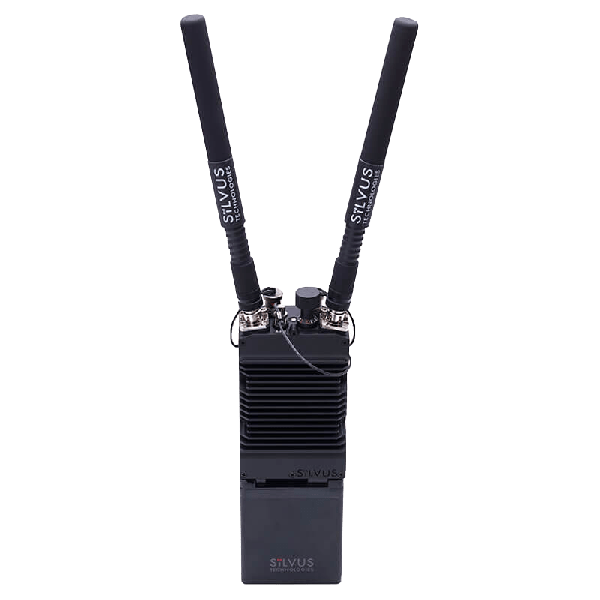
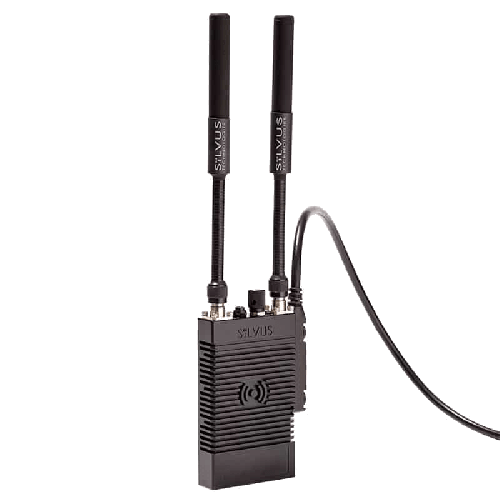
SILVUS StreamCaster 4200 ENHANCED PLUS MIMO Radio SC4200EP
- Details
- Characteristics
- Reviews
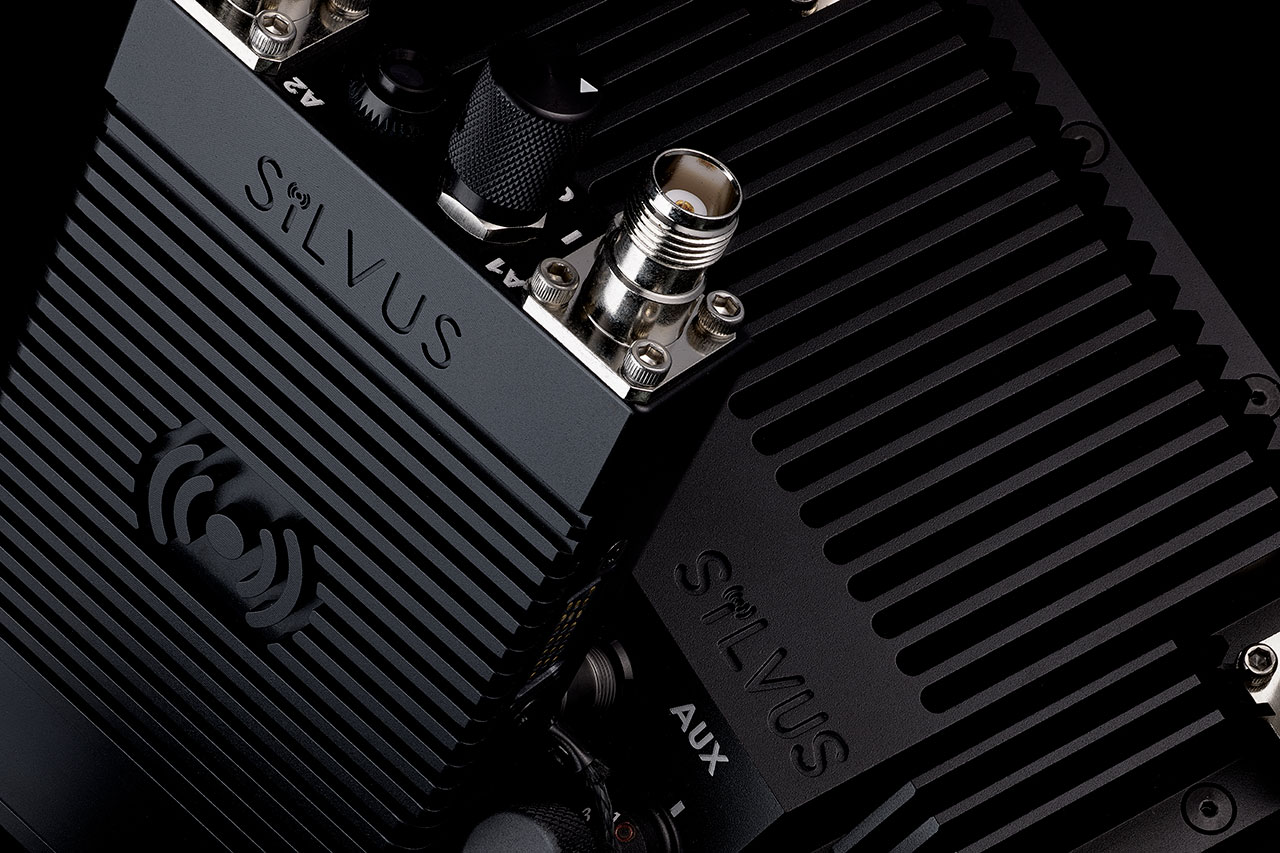
CURRENT STATE
Until recently, tactical radios were limited by outdated waveforms that provided secure voice transmission for establishing radio communication, while data transmission was performed at very low speeds. Today’s incompatible networks for voice and data transmission create increased demand for limited spectrum solutions and specialized multi-channel equipment, which is costly due to its size, weight, and power consumption (SWAP). Waveforms developed during the creation of the Joint Tactical Radio System (JTRS) were complex and did not meet the requirements of modern operational systems demanded by the rapidly changing battlefield environment. Modern operators require intensive use of broadband communication channels and the ability to connect multiple endpoint devices on the front line. Meeting these needs with traditional radio systems built on outdated technologies developed nearly 20 years ago is simply impossible today.
EVOLUTION
Over the past decade, radio systems using Mobile Ad Hoc Network (MANET) technology have evolved and addressed some of the challenges associated with outdated equipment. MANET systems enable peer-to-peer voice and data communication without the need for additional infrastructure. They also support autonomous relaying and routing, allowing multiple network topologies without a single point of failure in the communication system. However, MANET systems also have limitations. Some tactical-like radio devices using MANET technology are actually based on IEEE 802.11 (Wi-Fi) signals with routing algorithms layered on top. Such systems face challenges with mobility, interference resistance, and security. Other MANET-based systems were developed to overcome Wi-Fi limitations and do not use 802.11 signals, but they lack the high data throughput required to support growing demand for high-definition video streaming and sensor data processing.
MIMO REVOLUTION
To address this challenge, Silvus Technologies proudly offers its Mobile Networked MIMO (MN-MIMO) technology to special operations units and related organizations. MN-MIMO technology is the result of more than 15 years of research and approximately $55 million in development funded by the U.S. government. MN-MIMO uses the latest advances in military communications technology to deliver wireless video and data transmission in the most demanding environments where traditional radio systems simply fail. By utilizing COFDM modulation (up to 4x4 MIMO) and mesh networking capabilities, MN-MIMO provides greater operational range, higher reliability, and faster data throughput than any other commercial or military wireless standard currently available on the market. MN-MIMO technology is the foundation of Silvus StreamCaster radios. Two StreamCaster radios create a bidirectional link that allows transmission of video, data, and voice. Three or more StreamCaster radios tuned to the same frequency form a dynamic, self-healing wireless mesh network. This network operates effectively in virtually any environment in tactical conditions: in the air, on land, at sea, and between them.
INDUSTRY SOLUTIONS

Operational radio communication systems for law enforcement, military units, and emergency response teams. Communication that can save lives.
Critical communications| Brand | Silvus Technologies |
|---|---|
| Weight, kg | 0.425 |
| Primary interface | Ruggedized Push/Pull Connector 1x Ethernet, 1x RS232, DC Input (EB only) |
| Auxiliary interface | Ruggedized Push/Pull Connector 1x USB 2.0 Host, 1x USB 2.0 OTG |
| PTT interface | Ruggedized Breakaway Connector (Front Panel) |
| Dimensions | 101.6 x 66.8 x 38.35 mm (without connectors) |
| Frequency stability | 300 MHz to 6 GHz |
| RF interface | 2x TNC(f) |
| Sensitivity | -99 dBm @ 5 MHz BW |
| Battery validity period | Up to 12 Hours (6.8Ah Battery) |
| Operating temperature | -40... +65 °C |
| Material | Black Anodized Aluminum |
| Frequency band options | 400-450 / 663-698 / 902-928 / 1350-1390 / 1350-1440 / 1452-1492 / 1790-1850 / 2025-2110 / 2200-2300 / 2200-2500 / 2400-2500 / 4400-4700 / 4400-4940 / 4700-5000 / 5150-5250 / 5725-5875 МГц |
| Diagnostics | Spectrum Scanning, Statistics Logging, Temperature/Voltage Monitoring |
| Control interface | Multi-Position Switch 13 presets plus zeroize crypto Web-Based StreamScape Network Manager |
| Output power | 1mW - 4 W variable (up to 8 W effective w/TX Beamforming) |
| MIMO Techniques | Spatial Multiplexing, Space-Time Coding, TX/RX Eigen Beamforming |
| Data rates | Up to 100Mbps (Adaptive) |
| Status indicator | Tri-Color LED |
| Waveform | Mobile Networked MIMO (MN-MIMO) |
| Push-to-talk voice | G.711/G.722/Opus Codecs, RoIP Tethering, Dual PTT |
| Spectrum dominance | MANET Spectrum Analyzer (MAN-SA) MANET Interference Avoidance (MAN-IA) MANET Interference Cancellation (MAN-IC) |
| Latency | 7ms average (20MHz BW) |
| Mounting | 4-Hole Mounting Pattern (Through-Hole) |
| Power options | Twist-Lock Battery (BB) or Front Panel (EB) |
| Onboard storage | 64 Gb |
| Power consumption | 4,8 W - 24 W @ 4W TX Power / 4,8 W - 16 W @ 1W TX Power |
| Supply voltage, V | 9... 20 V |
-
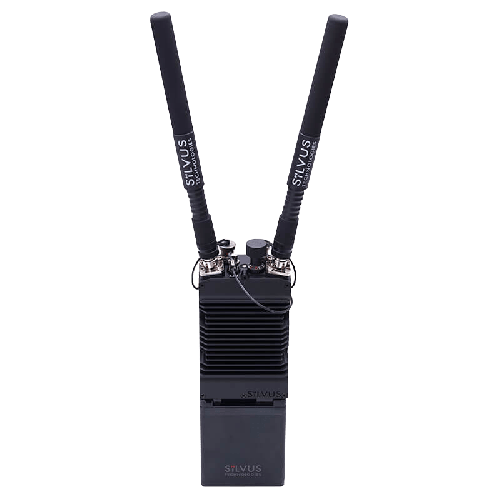 SILVUS StreamCaster 4400 ENHANCED MIMO Radio SC4400EPrice on request
 -
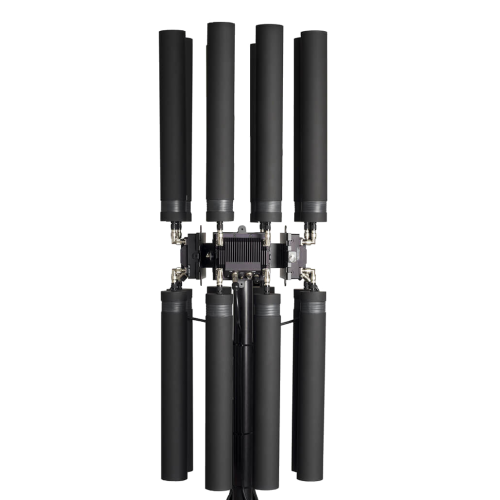 SILVUS MIMO Central transceiver arrayPrice on request
 -
 SILVUS StreamCaster LITE 4200 MIMO Radio SL4200Ціна за запитом
